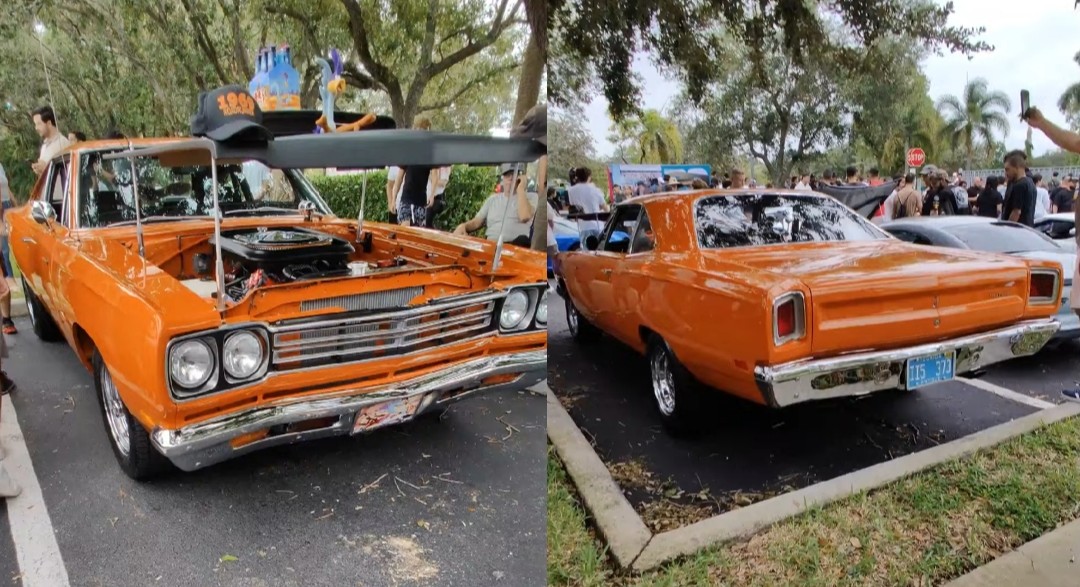
Walk through any modern car meet, and you are bound to pass a predictable sea of glossy carbon fiber, neon wrap jobs, and late-model sports cars revving for attention. But when an orange 1969 Plymouth Road Runner rolls in, pops its pins, and props its raw fiberglass hood high into the air, the entire energy of the blacktop shifts. It is loud, unapologetic, and a masterclass in American muscle history.
Born to Rule the Streets (On a Budget)
By 1968, the muscle car market was undergoing an identity crisis. Vehicles were getting heavier, more luxurious, and increasingly expensive. Plymouth saw an opportunity to pivot back to basics. They went to Warner Bros., paid $50,000 for the rights to use the Road Runner name and cartoon likeness, and spent another $10,000 developing a signature horn that replicated the iconic "Beep-Beep!"
The formula was beautifully simple: strip out the luxury, leave the bare-bones taxi-cab interior, and drop a massive, high-performance V8 under the sheet metal. For under $3,000 brand new, anyone could buy a factory-built machine capable of running a 14-second quarter-mile right off the dealership lot.
The A12 Package: Street-Legal Drag Racing
The specific setup on the car pictured points directly to one of the most legendary option groups in Mopar history: the mid-year A12 package. This wasn’t an options list for comfort—it was a factory drag-racing blueprint.
The Lift-Off Hood: To save weight and maximize airflow, Plymouth ditched the standard steel hood and hinges. In their place went a raw, fiberglass panel with a massive, functional air scoop. At the track, owners would pull four chrome pins and lift the entire hood off the car, just as you see imitated at car meets today.
The "Six-Pack" Punch: Underneath that scoop sits the iconic 440 cubic-inch big-block V8 paired with a triple two-barrel carburetor setup—famously dubbed the "Six-Pack." Cruising around the parking lot, it runs efficiently on just the center carb. But smash the gas pedal, and the outer two carbs snap open, dumping an absurd amount of fuel and air straight into the engine.
The Insurance Wink: Plymouth officially rated the 440 Six-Pack at 390 horsepower to keep insurance companies from panicking. In reality, dyno tests and track times quickly proved these engines were pushing well north of 430 horsepower right out of the box.
The Ultimate Car Meet Anchor
Seeing an orange A12-style Road Runner in the wild is a reminder of an era when performance wasn't dictated by lines of code, traction control, or launch algorithms. It relied entirely on mechanical linkage, heavy-duty suspension, and pure displacement. While modern supercars quietly idle with their computers doing the heavy lifting, this 1969 brute stands as a loud, proud monument to the golden age of mechanical horsepower.