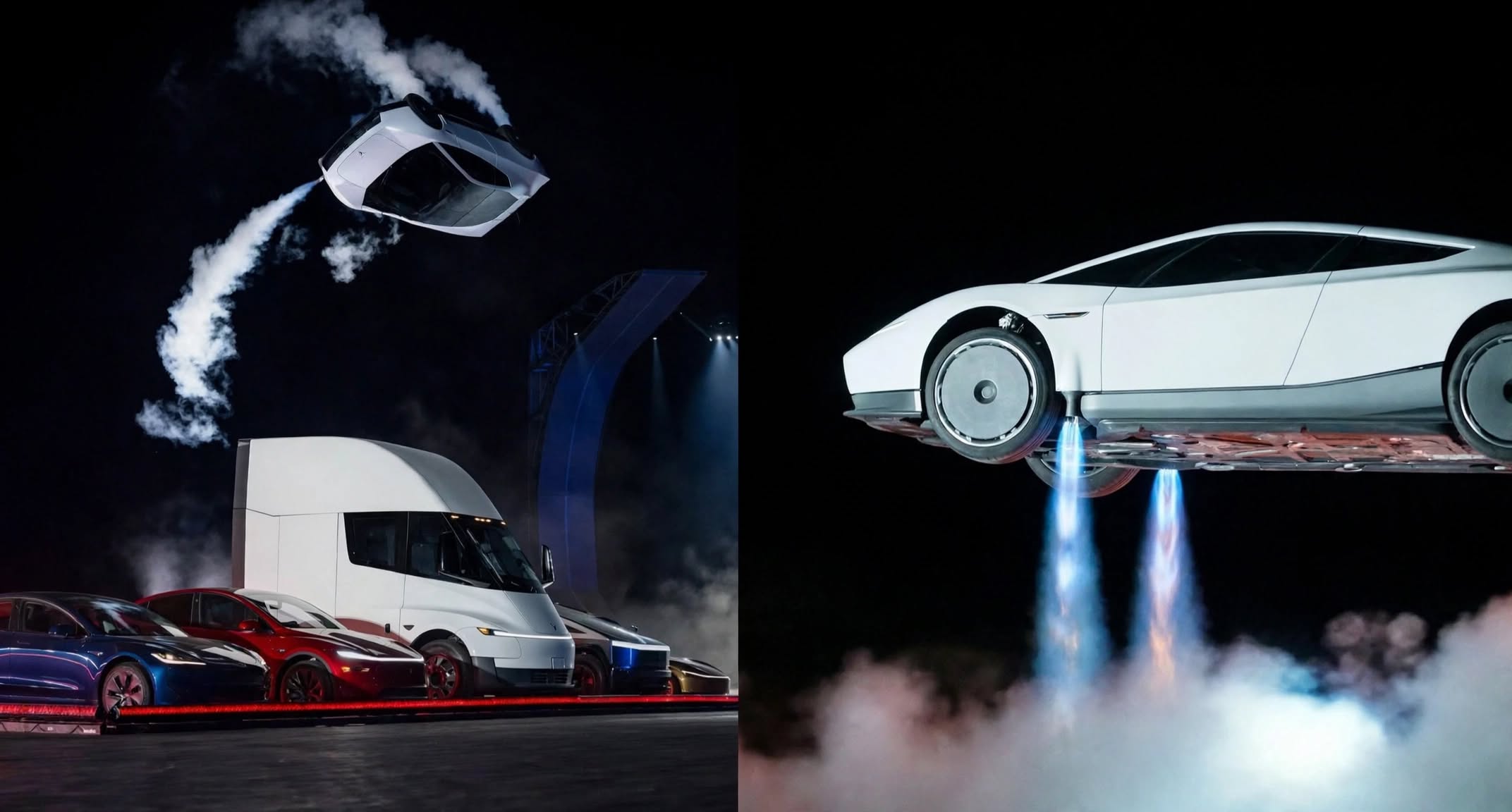
The concept of "flying cars" has shifted from science fiction fantasy into one of the most intense debates in the modern automotive and aerospace industries. When Elon Musk hinted that the long-awaited Tesla Roadster would not only be the fastest production car in the world, but would also literally have the ability to hover and briefly lift off the ground, the internet erupted with theories and speculation.
So, what is the truth behind this promise, and how does this technology actually work? Below, we break down the technical details, the physics behind the prototype, and the impact it could have on the future of mobility.
1. The SpaceX Package: Cold-Gas Thrusters
Unlike traditional urban air mobility concepts (eVTOLs) that rely on propellers or jet turbines, Tesla's approach to achieving liftoff relies directly on rocket engineering.
High-Pressure Nozzles: The vehicle integrates roughly 10 cold-gas thrusters strategically positioned around the body.
Ultra-High Pressure Air Tank: A composite-overwrapped pressure vessel replaces the rear seats to store compressed air at extreme pressures, continuously recharged by an onboard electric compressor.
Instant Thrust: By releasing this air at ultra-high velocities, the car generates immediate thrust that does not rely on tire traction against the asphalt.
Key Takeaway: This technology is not designed for long-distance cross-city flight, but rather to provide extreme acceleration, air-assisted braking, and controlled hover or short hops.
2. Defying Physics: Ground Effect and Inversion
One of the most intriguing aspects presented in technical demonstrations is the clever manipulation of ground effect. Using an underbody suction system, the car creates massive aerodynamic downforce—enough to theoretically keep it stuck to the ceiling of a tunnel or driving upside down on inverted ramps at high speeds.
When the system reverses the direction of the airflow, that same downward force turns into lift, allowing the vehicle to hover a few feet above the surface with high stability.
3. Regulatory and Safety Challenges
While the applied physics proves that the system is technically feasible, bringing a car equipped with rocket thrusters to public roads faces major hurdles:
Pedestrian Safety: High-pressure air blasted from the nozzles poses a significant safety hazard to pedestrians and nearby vehicles in urban environments.
DOT and NHTSA Approval: Department of Transportation regulations enforce strict safety standards that currently do not account for reactive propulsion systems on highway vehicles.
Weight and Range Constraints: The added weight of the heavy-duty compressor and pressure tanks directly impacts battery efficiency and overall driving range.
The Future of Mobility or a Marketing Masterstroke?
The Tesla Roadster with the SpaceX package represents far more than just another sports car—it acts as a rolling laboratory testing the convergence of electric vehicle engineering and aerospace technology.
While we may not see thousands of hovering cars floating over daily traffic anytime soon, these innovations continue to push the boundaries of acceleration, traction control, and aerodynamics for the supercars of tomorrow.
What are your thoughts on this collaboration between Tesla and SpaceX? Do you think we will see thruster-equipped vehicles on public roads before the end of the decade? Leave your comment below and share this article with fellow automotive and tech enthusiasts!